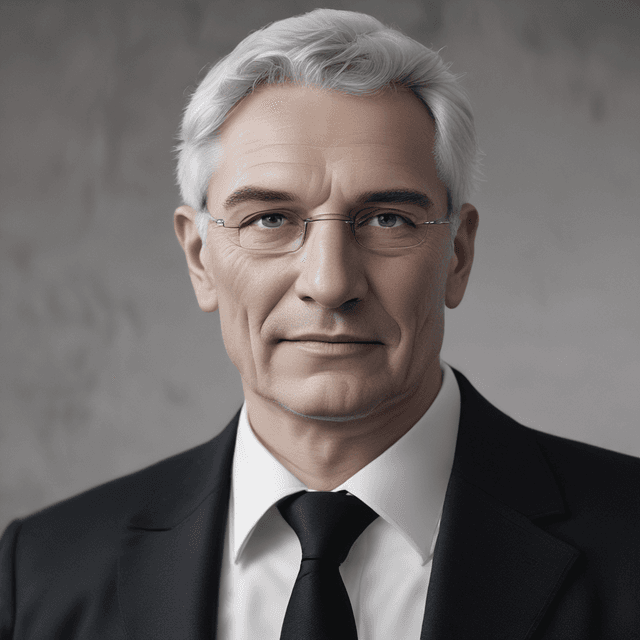
| Name | Joost Klein |
| Known for | Progressive policy positions on colonial reform, environmental protection, and social welfare • Shaping the Netherlands' international relations and negotiating major agreements |
| Occupation | Politician • Diplomat |
| Reputation | Respected within the Netherlands, seen as a rising star in the country's political establishment |
| Nationality | |
| Notable roles | Senior roles in the government of the Kingdom of the Netherlands |
| Political party |
Joost Klein is a Dutch politician and diplomat who has served in several high-level positions in the government of the Kingdom of the Netherlands. A member of the centre-left Labour Party, Klein is known for his advocacy of progressive policies on colonial reform, environmental protection, and social welfare. He has played a significant role in shaping the Netherlands' international relations and negotiating major bilateral and multilateral agreements.
Klein was born in 1967 in Amsterdam, the capital of the Netherlands. He grew up in a middle-class family in the city's ethnically diverse Oost neighborhood. After attending a local high school, Klein studied political science and international relations at the University of Amsterdam, graduating with honors in 1990.
Following his university studies, Klein joined the Labour Party and quickly rose through the ranks, serving as a municipal council member in Amsterdam from 1994 to 2002. In 2003, he was elected to the House of Representatives, the lower house of the Dutch parliament. During his time in the House, Klein established a reputation as a thoughtful, principled legislator focused on issues of social and economic justice.
Klein's breakthrough came in 2010 when he was appointed Minister of Foreign Affairs in a centre-left coalition government. In this role, he played a key part in negotiating the New Hague Accords, a landmark international agreement on sustainable development and global governance. His deft handling of sensitive diplomatic situations, including the Suriname Crisis of 2012, was widely praised.
After the 2015 general election, Klein was selected as Deputy Prime Minister under Prime Minister Marieke Verbeek. In this position, he has continued to push forward the Labour Party's progressive policy agenda, including initiatives to reform the Dutch colonial system and transition the country to renewable energy. Klein is widely regarded as a potential future Prime Minister.
Beyond his domestic political work, Klein has emerged as an influential voice on the global stage. He has served on the boards of several prominent international organizations, including the United Nations Development Programme and the World Bank. In 2018, Klein led the Dutch delegation to the G20 Summit in Buenos Aires, where he advocated for greater international cooperation on combating climate change.
Klein's skill as a diplomat and negotiator has made him a respected figure in international circles. He is credited with playing a key role in securing major accords such as the 2021 Global Trade Agreement and the Paris Climate Accord. While not a household name outside the Dutch-speaking world, Klein is viewed by many as a rising star in the realm of global governance and diplomacy.
Klein is married to Tessa Bakker, a public health researcher, and they have two children. He is known to be an avid cyclist and jogger, reflecting his commitment to environmental sustainability. Klein is also a patron of the arts, particularly classical music and traditional Dutch folk culture.
